
Mountaineering Gear Checklist: Build the List From the Route and Team Plan
There is no universal mountaineering kit. A nontechnical snow ascent, a guided glaciated route, and an independent alpine climb can share ordinary layers while requiring completely different skills and technical systems. Build the checklist from the exact route, current season, team plan, and official requirements—then test every connected component before departure.
The Direct Answer: The Route Document Comes First
Start with the current guide, operator, permit, or route information for the objective. Extract the required personal and group equipment without changing its meaning. Add systems for clothing, navigation, food, water, shelter, emergency response, and repair. Assign every shared item to a named carrier, then complete a compatibility and pack check as a team.
REI's reviewed mountaineering checklist is a broad reference across technical equipment, clothing, navigation, camping, food, water, and personal items. It is intentionally comprehensive; the exact route and qualified instruction decide what belongs in the final kit.
Convert Five Route Inputs Into the Checklist
| Planning input | Decision it controls |
|---|---|
| Route and season | Terrain, expected conditions, elevation, duration, camps, water, daylight, and known hazards |
| Skills and systems | Travel and protection systems the route actually requires and the team is trained to use |
| Team plan | Personal versus shared equipment, who carries each shared item, and what redundancy is intentional |
| Official requirements | Guide, operator, permit, land-manager, and current trip instructions that override a generic list |
| Turnaround and emergency plan | Conditions, timing, equipment, or team changes that end or alter the objective |
A checklist cannot replace instruction
Technical equipment is useful only with the judgment and practiced skills to select, inspect, and use it in the relevant terrain. If the route involves glacier, avalanche, rock, ice, or rope systems beyond the team's training, seek qualified instruction or an appropriate guide. Buying every item on a list does not close that gap.
Mountaineering Gear Checklist by System
Clothing and personal protection
- Layering system for the forecast and exposure
- Hand, head, eye, and skin protection
- Footwear matched to terrain and required equipment
- Dry or emergency insulation where the plan calls for it
Navigation and communication
- Route information and offline navigation
- Primary tools the team can use
- Communication and signaling for the location
- Power plan for the expected duration and conditions
Technical and team equipment
- Every item named by the route plan or guide
- Compatible components checked as complete systems
- Shared gear assigned to one carrier with team visibility
- Repair or spare items selected for credible failure points
Food, water, shelter, and emergency
- Food and water plan with route-specific margins
- Treatment, stove, and fuel systems where needed
- Shelter or bivouac plan for scheduled and unplanned stops
- First aid and emergency equipment matched to the team and remoteness
Expand each line with the exact item, size, quantity, specification, owner, and pack location. Preserve any wording supplied by the guide or operator. If their list names a minimum, a standard, or a required model characteristic, do not replace it with a vague category.
Separate Personal Gear From Team Gear
Put shared gear in its own category and assign one primary carrier to each item. Every team member should still know what the group has, where it is packed, and which planned system depends on it. Duplicate equipment should be an explicit redundancy decision, not the result of two people assuming the other person forgot.
| Shared item | Primary carrier | Related parts | Pack location |
|---|---|---|---|
| Exact item name | Named teammate | Parts and quantity | Accessible location |
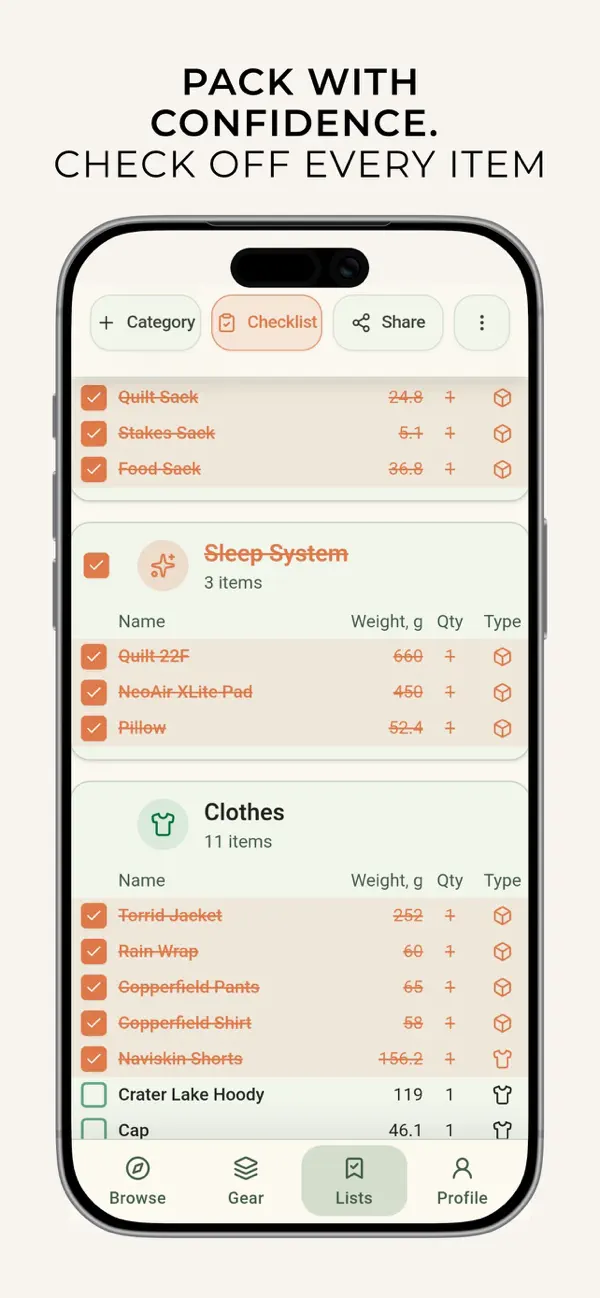
Share the finished list before the team gear check. MetaGear can publish a gear list as a web link that opens in a browser, which gives teammates a common reference without requiring them to install the app.
Run a Full Compatibility Check
Owning every category does not prove that the system works. Assemble and wear the actual trip configuration in a controlled setting. Check these interfaces before the final pack:
- Boots fit the exact traction or climbing equipment selected for the route.
- Harness, clothing layers, pack, and technical equipment can be worn together.
- Gloves still allow the team member to operate required closures and tools.
- Batteries, chargers, cables, and devices form one complete power system.
- Tent, stove, repair, and shared systems include the parts assigned to the team.
- Critical gear can be reached in the order the route is expected to demand it.
Record the trip-ready configuration rather than a catalog weight or a stripped item. The guide to weighing outdoor gear accurately explains how to include the parts and quantities you actually carry.
Stage the Pack in Route Order
Pack for the sequence of use. Keep navigation, weather protection, food, water, and time-sensitive technical equipment accessible. Protect insulation and electronics as required. Put camp-only items deeper, but do not bury emergency equipment beneath gear that must be unpacked in exposed terrain.
Complete a team check with the loaded packs. Confirm the assignment of shared gear, test the expected transfers, and weigh the real loads. If one pack is impractical, rebalance by role and access needs rather than by weight alone.
Keep Route Variants and Final Checks in MetaGear
Save personal equipment in Gear Locker, then build separate pack lists for objectives that require different systems. Add quantities, notes, custom details, and measured weights. Share the list for the team review and use Checklist Mode during the final gear check.
For nontechnical cold-weather objectives, use the winter hiking route-card method. For a multiday camp system, cross-check the backpacking checklist by function without allowing it to replace route-specific technical requirements.